
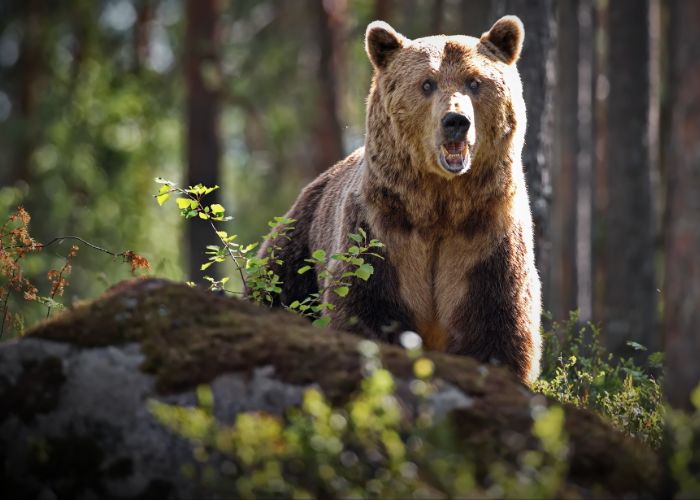
Our brain reduces inherent uncertainty in our environment by using the senses to predict outcomes probabilistically. What’s the probable outcome of taking a sip from a stream that is frequented by apex predators? Most people would flatly avoid that circumstance. But what if you were out on a hike and forgot to pack a thermos? You stumbled on to an unknown stream, and found yourself overwhelmingly thirsty? You may be flooded with a sense of uncertainty. You might carefully scan your environment first visually, then become very still to hear the movements of any large mammals that may be in the vicinity. If none can be sensed, you move closer to the stream slowly and as quietly as possible. Just as you have made it to the edge of the stream a large pinecone tumbles out of a nearby tree, crashing to the underbrush. You feel a surge of fear and misidentify the source of the sound. It’s a bear! And you run like hell to safety. Likely the misidentification of the pinecone resulted from a previous experience with meeting an actual bear in the woods. The memory of that experience has been emblazoned in your brain waiting to be recruited by “similar” circumstances. When the pinecone sounded, your brain was overwhelmed by the limbic system, its fear response was recruited, and that blunted your ability to update your senses, to consider that the noise did not indicate BEAR! The prediction machine between your ears could not update through the senses due to overwhelming fear.
Now replace the bear with people. Growing up in an environment with unsafe caretakers creates memories that interfere with predictions leading to the misidentification of people and situations as safe that may not be. Or conversely, prediction error may lead to the misidentification of people and situations as dangerous that are in fact safe. Many people in heightened circumstances such as making a friend, falling in love, or beginning a new family, cannot update with their senses due to old fears and so revert to memory. If fear is common to childhood memories, then it may be associated with connection to others, especially to intimate others, there to be recruited to infuse relationships in current functioning. This kind of over-generalization of fear that is created in early childhood, the proverbial taking a bath in fear, due to the failure of our brain networks to update our perceptual frame, can become chronic and the source of anxiety, depression, ADHD, and CPTSD.
How do we fix that? At Neurofeedback Services of NY, we focus on reducing fear through the neurofeedback training of the Autonomic Nervous System (ANS). You’ve probably heard of the fight, flight and freeze and rest digest networks? Those are the very same networks we target for our training. We lower the sensitivity to the fear response by regulating sympathetic drive, the arm of the nervous system that creates fight, flight and freeze behavior. We improve relaxation by regulating the parasympathetic arm of the nervous system that promotes rest and digest capacities. A well-regulated ANS allows us to focus our goal directed behaviors more successfully. That fluidity increases resilience by lowering our reactivity to triggers from our past. Moreover, fluid major behavioral networks in brain produce better predictive mechanisms. If I can predict the outcome of previously unmanageable situations, I can avoid the consequences more often. ISF neurofeedback training allows for better predictive processes leading to less reflexive behavior. It reduces our vulnerability, from a less-than-optimal early childhood environment, to triggers in the current environment. It makes good judgements more likely, leading more often to satisfactory outcomes in life.
Is Your Brain Holding You Back? Discover How Neurofeedback Can Help!
Are old fears and past experiences influencing how you navigate life today? Imagine unlocking the ability to accurately predict your surroundings, make better judgments, and reduce anxiety. At Neurofeedback Services of NY, we use cutting-edge neurofeedback training to help you retrain your brain’s response to fear and stress, opening the door to more fulfilling relationships and a calmer, more resilient mind.